
Scaling AI Training: Deploying a Remote AI Trainer Team for a Construction AI Startup
- Client
- Gridline AI (name changed)
- Industry
- AI Software (SaaS) for Construction
- Location
- California
- What we built
- A dedicated remote team of vetted AI tool trainers, with a team lead and quality reviews
The Situation
Gridline is an AI software startup building tools that read and check construction drawings. To improve its AI, the company needs a steady stream of correctly labeled drawings and careful human reviews of what the AI produces.
That work takes people who can read construction drawings, follow detailed guidelines, and stay consistent across thousands of tasks. One or two people weren't enough to keep up with the startup's training plans.
The Problem
Hiring and training AI trainers one at a time was slow, and the startup's engineers didn't have time to recruit, onboard, and manage a group of trainers themselves.
General labeling workers could follow instructions but didn't understand construction drawings, which led to mistakes in the training data. Without shared standards and quality checks, different trainers also labeled the same things in different ways.
What We Built
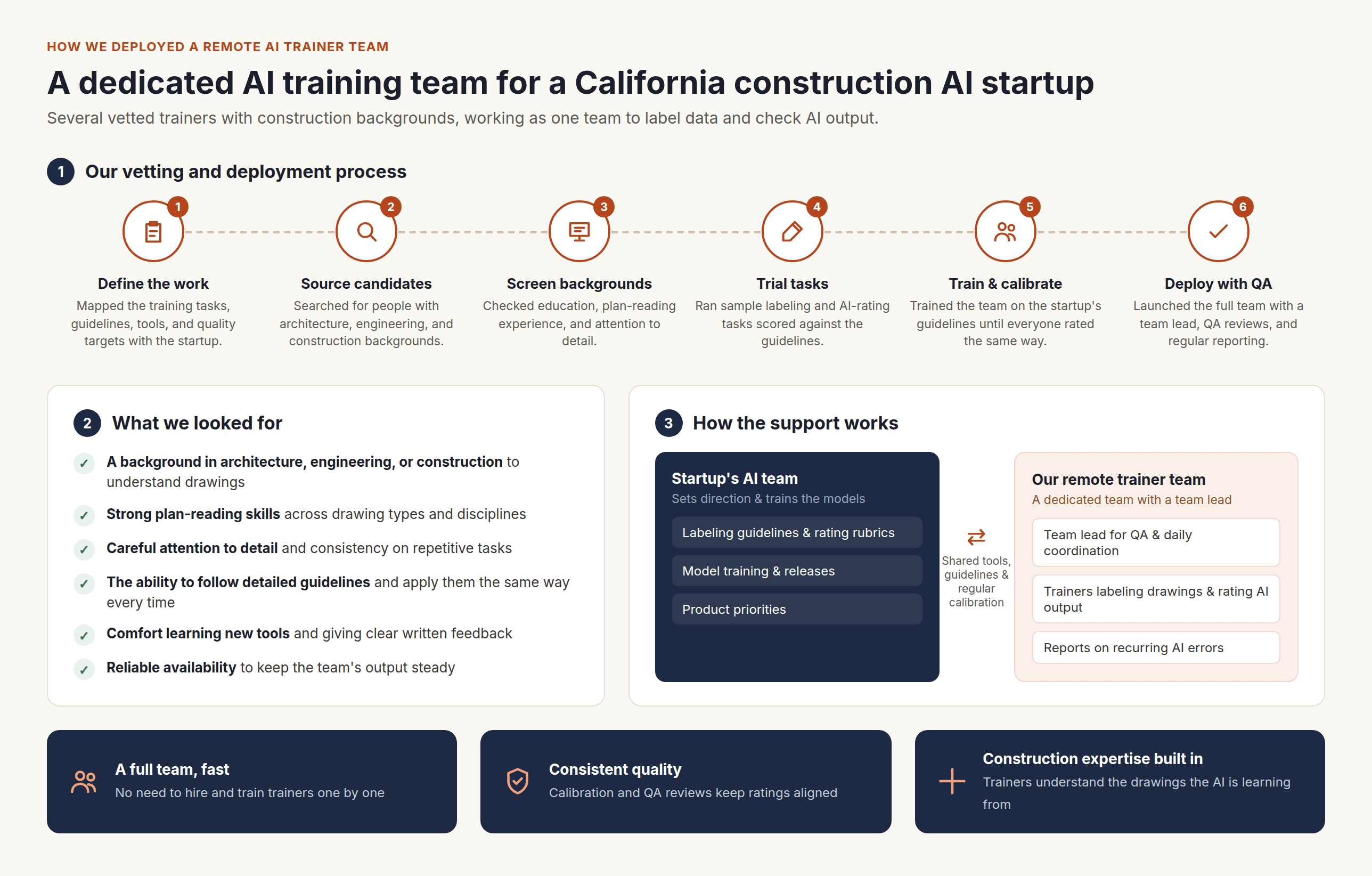
We built and deployed a dedicated remote team of AI trainers for this contract. Instead of placing one person, we vetted several trainers with construction backgrounds, trained them as a group, and put a team lead in place to manage quality and day-to-day coordination.
Defining the work
We worked with the startup to map out the training tasks, labeling guidelines, rating rubrics, tools, and the quality they expected.
Vetting candidates with the right background
We searched for people with architecture, engineering, or construction backgrounds and strong plan-reading skills, then screened their education and experience.
Trial tasks
Candidates completed sample labeling and AI-rating tasks, scored against the startup's guidelines. Only those who were accurate and consistent joined the team.
Training and calibration
We trained the team together on the startup's guidelines and ran calibration rounds until everyone labeled and rated the same way.
A team lead and QA reviews
A team lead coordinates daily work, reviews samples of each trainer's output, and answers guideline questions, so quality stays high as volume grows.
Feedback for the engineers
The team reports recurring AI mistakes back to the startup's engineers, so they know where the models need more training.
The Results
What changed for the startup:
- The startup gained a full, ready-to-work AI training team without recruiting and managing trainers itself.
- Training data and AI reviews are handled by people who understand construction drawings.
- Calibration and QA reviews keep quality consistent across the whole team.
- The team lead gives the startup one point of contact for the entire training effort.
- Clear reports on AI errors help the engineers focus their work where it matters most.
The Takeaway
Training AI for construction takes more than one person and more than general labeling skills. By building a vetted, calibrated team of trainers with construction backgrounds and a team lead to manage quality, we gave Gridline the capacity to train its AI faster without sacrificing accuracy.
Client name has been changed to protect client confidentiality.