
Training AI to Read Construction Drawings: Data Annotation and Output Review for an AI Startup
- Client
- Gridline AI (name changed)
- Industry
- AI Software (SaaS) for Construction
- Location
- California
- What we built
- Construction-savvy data annotation and AI output review (human-in-the-loop quality control)
The Situation
Gridline is an AI software startup building a tool that reads construction drawings automatically. It can find the views on a sheet, pick out tables and schedules, count fixtures, and pull key numbers, saving engineers and reviewers hours of manual checking.
To get there, an AI model has to learn from thousands of drawings that have been labeled correctly by people who understand what they're looking at. Construction drawings are dense and technical, and labeling them well takes someone who can read plans, not just draw boxes.
The Problem
The startup's engineers needed a steady supply of accurate, consistently labeled drawings, plus a reliable way to check whether the AI was getting things right. Their own team didn't have the time or the construction background to do this at scale.
General labeling vendors could draw boxes, but they couldn't tell an elevation from a legend, a standard light fixture from an emergency one, or spot when a number in a photometric table had been misread. Small mistakes in training data teach the AI the wrong lessons, and those errors show up later in front of customers.
What We Built
We provided a team with construction drawing experience to work directly inside the startup's labeling and review tools. Our work covered two parts of the AI training cycle: creating high-quality training data, and checking what the AI produced.
Labeling drawing sheets
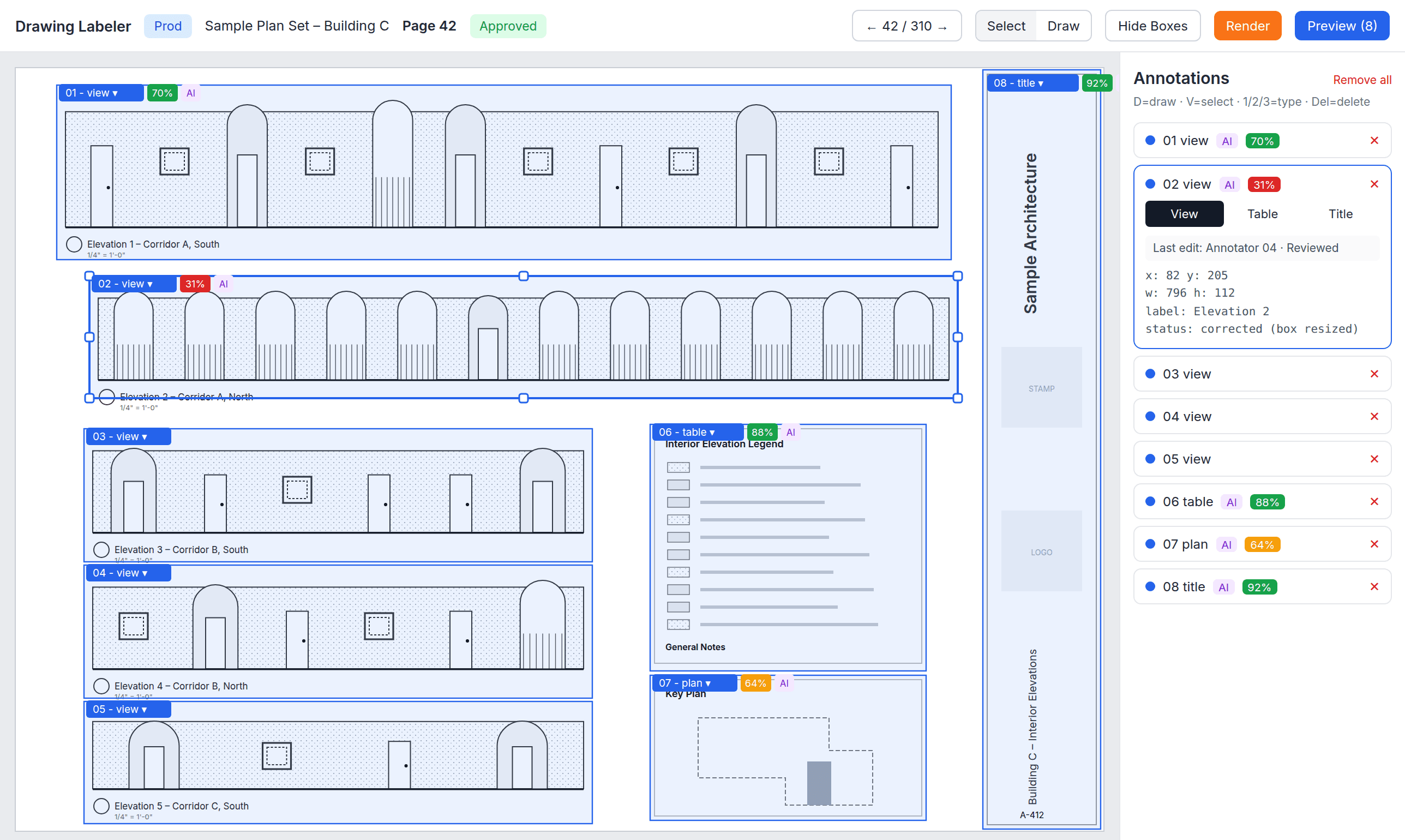
Our team marked out each part of a drawing sheet, such as elevations, plans, legends, schedules, key plans, and title blocks, and tagged each one with the right type. This teaches the AI how a drawing sheet is organized.
Reviewing AI predictions
When the AI suggested its own labels, our team checked each one, starting with the ones it was least confident about. Boxes were resized, retyped, or removed so the final labels were correct.
Checking counts and symbols
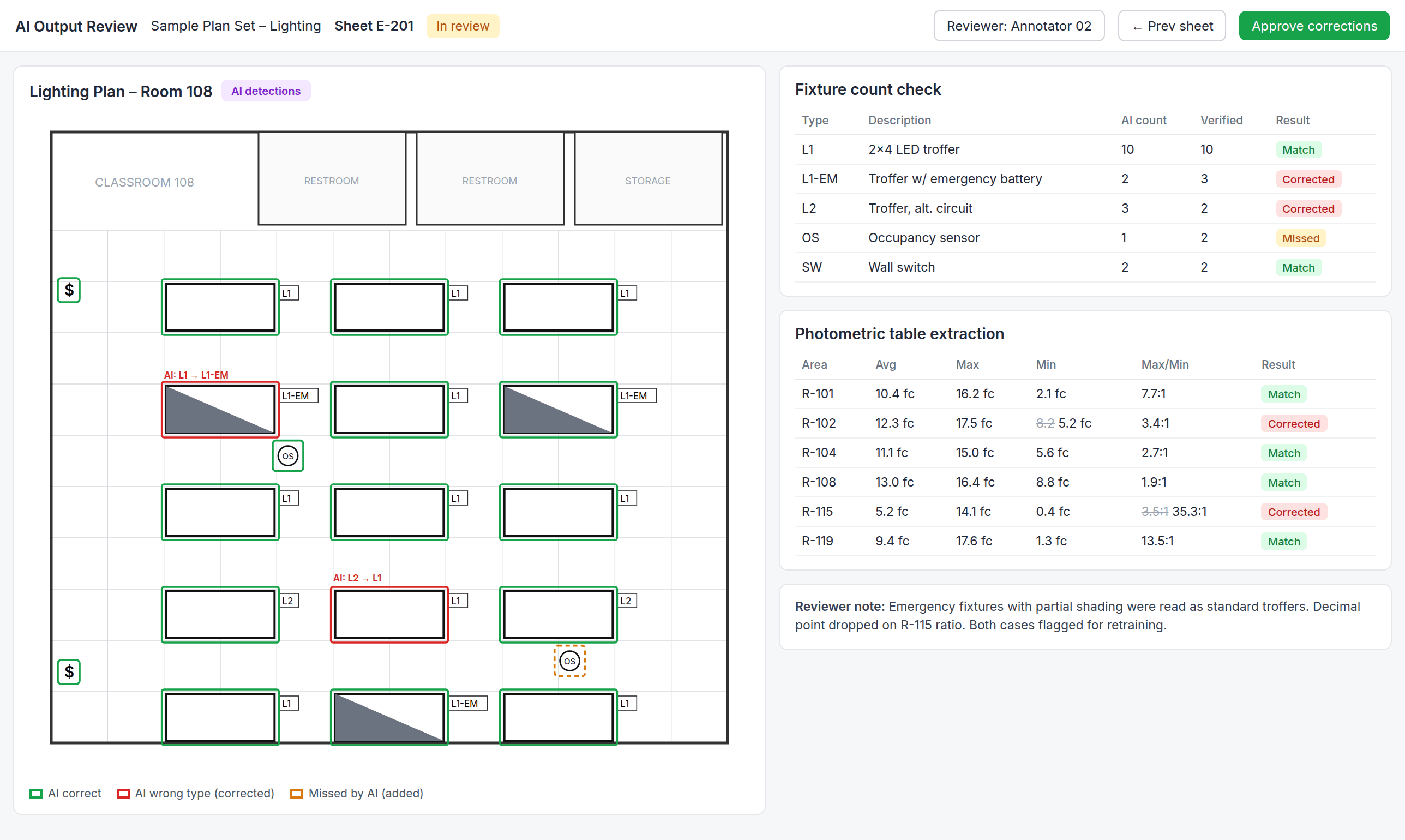
On plans such as lighting layouts, we verified the AI's fixture and device counts against the drawing and caught symbols it missed or misread, like emergency fixtures or occupancy sensors.
Verifying extracted data
When the AI read tables like photometric statistics, we checked every value against the source drawing and corrected errors such as dropped decimal points or swapped numbers.
Feedback for the engineering team
Recurring AI mistakes were written up as clear notes so the startup's engineers knew exactly what to retrain on next.
Consistent quality standards
We followed shared labeling rules and approval steps, so every sheet was labeled the same way no matter who worked on it.
The Results
What changed for the startup:
- The engineering team received a steady flow of accurately labeled drawings to train and test their models.
- Errors in AI output were caught and corrected before they reached customers.
- Clear notes on recurring mistakes helped the engineers focus their retraining where it mattered most.
- The startup's own team could stay focused on building the product instead of labeling data.
- Construction knowledge was built into the training data, which made the AI more useful to real-world engineers and reviewers.
The Takeaway
AI is only as good as the data it learns from, and construction drawings are hard to read without the right background. By pairing careful data labeling with a human check on the AI's output, we helped Gridline train a tool that understands drawings the way the industry does.
Client name, tool names, drawings, and all figures shown are illustrative and have been recreated to protect client confidentiality.